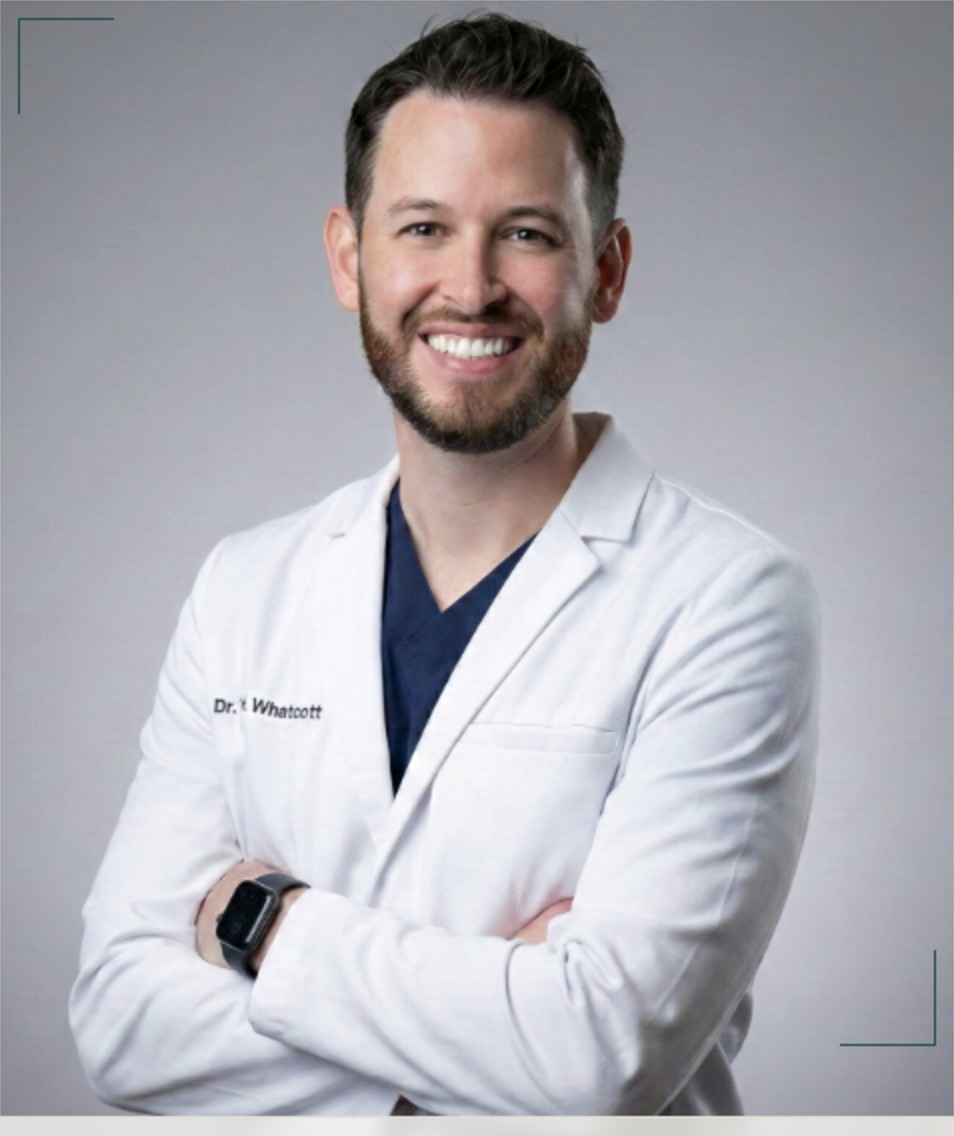
Mark D. Whatcott, DDS
General dentist Lakewood, Colorado Eight years full-scope Updated July 2026

Restorative is the work I care about most, and LANAP is not a sideline.

I own a general practice in Lakewood and have run it solo since 2022. Crown and bridge above all, and I want a full schedule of it. I also run two programs most general offices refer out, LANAP laser periodontal therapy and an airway and sleep program I built. I enjoy the hell out of LANAP, and I would happily take a week that ran half periodontal surgery and half everyday general dentistry.

Status

Working through an ownership transition. What I want next is a practice with other dentists in it.

Credential

Fellow, Institute of Advanced Laser Dentistry. DDS, LSU School of Dentistry, 2018.

Dr. Mark Whatcott, DDS
Mark D. Whatcott, DDS
Denver metro, Colorado

What a normal week is.

Restorative and prosthodontics

Core of the week

Crown and bridge is the strongest part of my workflow, 600+ delivered at Colorado Advanced Dentistry, alongside full-scope direct restorative, fixed and removable prosthodontics, implant restoration, and injection-molded composite resin smile makeovers. I ran same-day crowns and onlays toward the end of my associate years. Chairside milling is the one thing I have wanted in my own office and never had.

LANAP laser periodontal therapy

Some weeks, half of it

Part of the week rather than beside it. I would happily run a schedule that was half periodontal surgery and half everyday general dentistry, and some weeks it lands close to that. It is also the only part of my practice where I can show outcomes tooth by tooth: the protocol, what the evidence supports, and one case charted for 40 months are all below.

Surgery

2,500+ career

More than 2,500 extractions across my career, including surgical and impacted cases, plus socket grafting and ridge preservation. I refer more of these out now than my skill set requires.

Implants are my one thin spot and I would rather say so: roughly 15 placed, about half guided, in a single associate year at Robinson Dental Group, none since 2022. I am interested in rebuilding it.

Endodontics

Referred out for imaging

Anterior, premolar, and molar endodontics from high-volume associate experience, reciprocating rather than rotary, which is considerably faster in my hands. I enjoyed this work when I could do it efficiently. I refer it out at my own practice for imaging reasons rather than scope, and I would keep these cases anywhere a CBCT supports them.

Chairside technology

Fully paperless

Fully digital records in Open Dental, intraoral scanning and digital restorative design, CBCT interpretation, and a standardized clinical photography protocol used on every complex case.

Not a sideline

Two programs most general offices refer out.

01Certified, IALD

LANAP laser periodontal therapy

How I frame it before anything else. Periodontal disease is chronic. LANAP is a way to manage it, not a one-time fix, and I say that at the first appointment rather than at the end. Maintenance is part of the plan from the beginning.

What the appointment looks like. A thin laser fiber clears diseased tissue, the root is debrided with a piezo ultrasonic scaler, and the gum reseals against the tooth using the patient's own fibrin clot. No scalpel, no sutures, no grafts or membranes. A full-mouth case is two appointments about 24 hours apart, one side each, three to four hours of chair time in total.

The last step, and why. The last thing I do is adjust the bite on the worst-affected teeth. Swelling from periodontal disease pushes a tooth out of position over time, and by the time I am treating it, that tooth is usually one of the few still holding the patient's bite. Taking it out of heavy contact gives it room to settle back while the site heals.

The next morning, and the week after. Without a flap or a releasing incision, recession is usually minimal, which matters in the smile zone. Across every LANAP case I have treated, including full-mouth cases in severe disease, I have not written a prescription for anything beyond ibuprofen. Pain response varies and I set expectations case by case, but that is my record. I ask how they slept.

Who it fits. Wider than most people assume. I have treated patients in their twenties and patients in their seventies, people with diabetes, smokers, cases that were one stubborn site and cases that were the whole mouth. Patients decline a periodontal referral over cost, inconvenience, and not seeing oral health as a priority. Keeping the surgery in house removes the first two.

  • PerioLase MVP-7
  • IALD live-patient continuum
  • Fellow since 2023
02Live since 2026

Airway and sleep dentistry

An in-house, dental-scope program I built and launched this year. Home pulse-oximetry screening, an airway health consultation where we go through the patient's own overnight data, then mandibular advancement appliance therapy and a re-measure. The first appliance was delivered in July 2026. The hygienists do most of that screening and the program doesn't work without them. They have the patient for an hour and I have them for ten minutes, so they're the ones who find out whether someone is actually curious about how they sleep.

Training is Spear Education, Airway Prosthodontics and Sleep Dentistry with Jeff Rouse and Jamison Spencer, January 2026, following Spencer's appliance-first approach.

Scope

I don't diagnose sleep apnea, and I say so to every patient. That call belongs to a physician. What I do is screening and appliance therapy; ENT, sleep medicine, primary care, and orthodontics take anything past dental scope. The program is a few months old, so there is nothing to report yet on outcomes or volume.

Case 01 · LANAP · de-identified 46-year-old man · full mouth · two surgical visits

149 deep sites, charted for 40 months.

Three teeth were beyond saving and came out the day of surgery. Everything below counts only the 25 teeth kept and followed. A site is one of six probing points around a tooth, charted at baseline, at twelve months, and again at 40 months. Nothing here is averaged across patients; this is one chart.

  1. 01Baseline, before surgery
  2. 02Twelve months
  3. 03Forty months, most recent exam
Deepest pocket
5 mm
Sites 5mm or deeper
3 of 149
0
5MM
10MM
Each mark is one probing site 5mm or deeper149 at baseline
5 to 6mm, 103 sites 7mm or deeper, 46 sites
40 months Month 40 of 40
Case 01, charted values
Exam Deepest Sites 5mm+ Sites 7mm+
Baseline8mm14946
12 months6mm40
40 months5mm30
  • 146 of 149 sites closed, 98%
  • No further teeth lost
  • 12 maintenance visits over 40 months

Three of the 149 sites never closed. At 40 months they are still charted at 5mm or deeper. They are counted as failures inside the closure figure, not set aside from it.

Baseline, 2022Before surgery
Deepest pocket
8mm
Sites 5mm+
149
40 months, 2026Most recent exam
Deepest pocket
5mm
Sites 5mm+
3

Both panels share one scale: 0 to 10mm, and 0 to 149 sites.

Photographs of this case are withheld pending a purpose-specific release.

Case 02 · LANAP · de-identified59-year-old woman · lower left and lower right · one surgical visit

A 12mm pocket, and all 24 sites closed.

She has diabetes and obstructive sleep apnea, which is the combination people assume puts a patient out of range for this. Two quadrants, one visit, and she is still on three-month maintenance almost three years later.

  • 12mm
    Deepest pocket
    before surgery
  • 24of 24
    Sites closed
    at the most recent exam
  • 35mo
    Charted follow-up
    most recent May 2026
  • 0
    Teeth lost
    since surgery
The record

163 patients since November 2022.

536 LANAP quadrants treated in total. Every figure is from my own caseload, not from published data. Teeth removed on the day of surgery as part of the surgical plan are counted separately, not as retention failures. Bars are drawn on true scales and none of the axes are cropped.

Tooth retention, counting only teeth that carried a pocket 7mm or deeper before surgery
98%
One year
708 of 721 kept, 13 lost
97%
Two years
323 of 334 kept, 11 lost
95%
Three years
159 of 168 kept, 9 lost
Kept Lost
Deep sites per patient, median, first-time full-mouth cases
Before surgery
66.5
Most recent exam
8.5
Pocket closure in that same group, median
86%
A closed site measured 5mm or deeper before surgery and 4mm or shallower at the most recent exam.

LANAP reduces periodontal disease. It does not cure it. Most of these patients still carry a pocket or two deeper than I would like, maintenance is lifelong, and the results above hold only as long as patients keep coming back.

The FDA clearance is specific to the PerioLase and covers marketing a regeneration claim, which is not the same as proof of a cure. The human histology behind it is two small studies, roughly sixteen teeth, with no independent replication, and there is no long-term head-to-head against flap surgery.

How I practice.

Evidence

I check the literature before I change how I treat something, and I will tell you where the evidence behind a procedure I offer is thin. The LANAP section above does exactly that instead of overselling.

Materials

I read the instructions for use on my materials start to finish, and I built a searchable database of them so the whole team can pull the exact manufacturer protocol, including mid-appointment.

Documentation

I write down what we do: procedure documentation, tray setups, training standards. The team executes the same way twice, and a new assistant learns the practice's method rather than my mood that day.

People

I build my assistants up until they can talk a case through with me, and I want to be taught too. The fastest I ever learned was in a group practice, absorbing cases from the doctors next to me.

Diagnosis

On complex cases the patient sees their own photographs and radiographs and reaches the diagnosis with me before any treatment is proposed. I ran that cohort against procedure-matched controls in my own data. Those patients accepted more treatment and stayed with the practice longer.

Experience and credentials

General Dentist and Owner
Colorado Advanced Dentistry

2022 to present · Lakewood, CO
  • Bought the practice in 2022 and have run it solo since, treating a broad case mix from routine restorative through surgical extractions and advanced periodontal care.
  • Built and run two programs from scratch: LANAP laser periodontal therapy, and a dental-scope airway program with home pulse-oximetry screening, airway health consultations, and appliance therapy.
  • Rebuilt the clinical workflow around written procedure documentation and training standards, so the same case runs the same way regardless of who is assisting.

Associate General Dentist
Robinson Dental Group

2018 to 2022 · Lake Charles, LA
  • My first practice out of dental school: a fast-paced group of up to four doctors, where I could take a case down the hall and talk it through.
  • Carried a wide daily case load across oral surgery, endodontics, restorative, and implant dentistry.
  • Trained fellow doctors and staff on practice-management software, CBCT analysis, intraoral scanning, and four-handed chairside efficiency, and built the lab-management system the group used to track case turnaround.

Credentials and advanced training

Fellowship
Fellow, Institute of Advanced Laser Dentistry, 2023 to present. Certified in the Laser-Assisted New Attachment Procedure through the IALD's year-long, live-patient training continuum.
Spear
53.25 CE credits since 2024, with a campus workshop every year: Treatment Planning with Confidence, March 2024. Occlusion in Clinical Practice, January 2025. Airway Prosthodontics and Sleep Dentistry with Jeff Rouse and Jamison Spencer, January 2026.
Licensure
Colorado dental license, active and in good standing. Current BLS certification. DDS, Louisiana State University School of Dentistry, 2014 to 2018. B.S. Biological Sciences, University of Arkansas, Dean's List all years, 2012 to 2014.
Technology and workflow

The process work is where the software came from.

The tool I reach for most is a clinical one: a searchable database of the instructions for use for every material in the practice. Before a complex case I pull the exact manufacturer protocol as a printable sheet.

I also built an internal reporting and documentation toolset with AI coding tools, read-only against Open Dental, covering production and financial reporting, huddle prep, and voice-dictation clinical notes. The periodontal analysis on this page came out of that work: 163 patients' probing charts parsed site by site, baselines reconciled, and a data-contamination bug caught that had been faking a 21% failure rate.

What travels is the judgment, not the software. I can say quickly which parts of an administrative load are worth automating and which are not, and I am glad to advise as part of the job. Building anything specific is its own conversation about scope and terms, kept separate from clinical days.

How I work

I show people their own mouth first. The photos, the scan, the probing depths, on a screen where they can see what I am seeing. Then we decide together.

When something is likely to work, I say so plainly. When the evidence behind it is thinner than the marketing, I say that too. I have lost cases that way, and I would still rather a patient hear a smaller promise and get a real result.

Mark Whatcott, DDS